


Single Phase Hybrid Inverter with Generator Input for Extended Power Outages
A generator can supply enough power for household loads yet fail to maintain battery charging when a pump or refrigerator compressor starts. The generator's voltage regulator responds to the sudden current demand, engine speed briefly falls, and the inverter may disconnect its AC input before the generator recovers.
An example of a common compatibility risk of a Single Phase Hybrid Inverter with Generator Input is the ability to operate for extended periods without utility power. Nameplate capacity is only one consideration. AC acceptance limits, charging current, transient response, and the battery configuration are key considerations in assessing whether a system can operate reliably for extended periods without utility power.
1. Generator Compatibility Starts with AC Input Behavior
Hybrid inverters can use generator power as an alternative AC source and may reject that power if the generator does not maintain the required frequency and voltage.
Small generators are load step sensitive. When a battery is charged, the increased electrical demand can cause voltage sag. If the inverter rejects that input, the generator load drops, the voltage recovers and the inverter may reconnect. This can cause a cyclic condition that may result in the system never charging the battery.
Three settings should be checked:
•Acceptance of AC input: A wider voltage window should allow the inverter to accept the power. Wider limits might lessen unwanted disconnections, but it will not remedy excessive frequency variation or distortion of the waveform.
•Charging current: Limit charging current in order to supply capacity for other loads.
•Source priority: Choose the mode that will ensure that the generator is the source of power prior to the battery and solar power.
The mode for generator compatibility and automatic generator starting are different modes. A hybrid inverter will most likely accept generator AC power without controlling the generator's ignition and/or providing a dedicated generator connection.
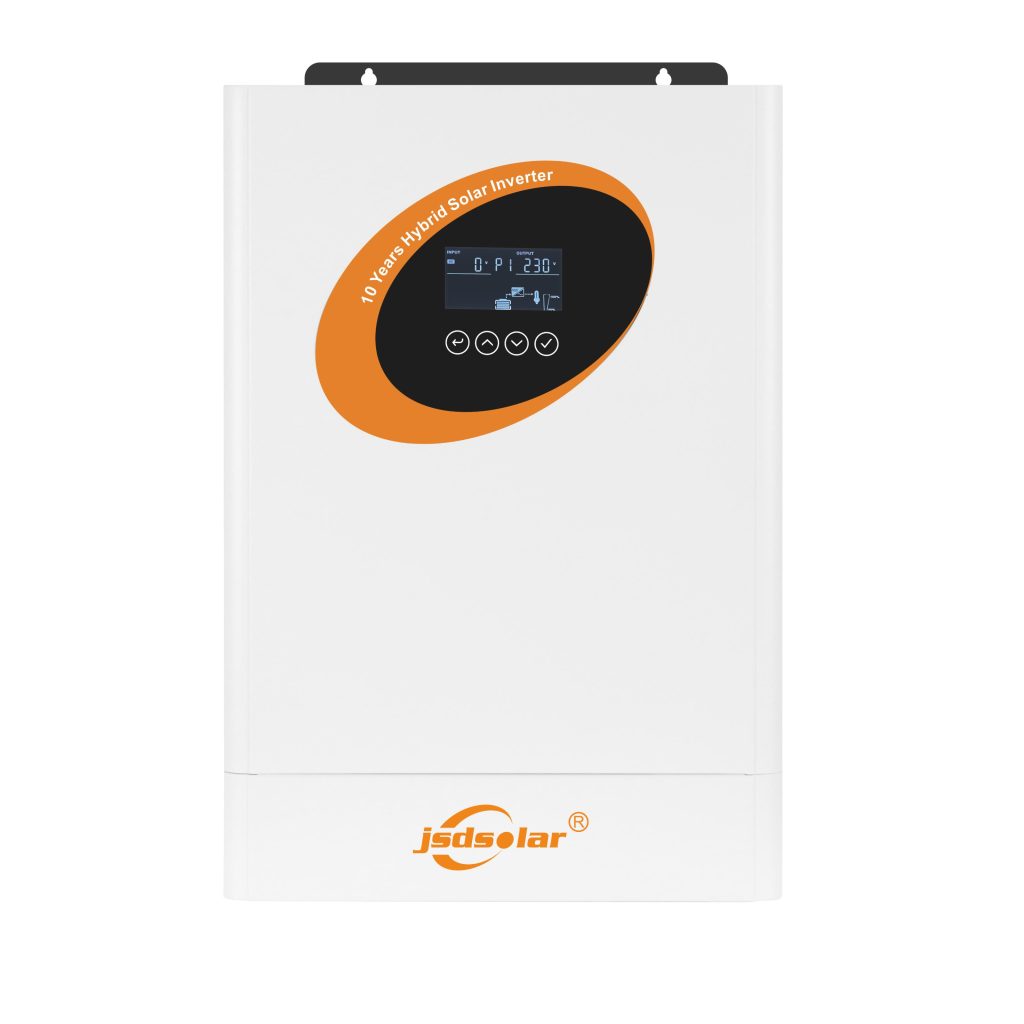
For the JSDSolar J4000HC, generator compatibility is documented in the user guide. Automatic start capability, generator specific terminals and adjustable input current limits should be addressed during the system design.
2. What Do the J4000HC Specifications Mean for Generator Selection?
The J4000HC employs a 24V battery platform, and can operate with single phase AC. The J4000HC's data provides a set of design constraints.
| Specification | J4000HC Technical Data | Design Implication |
| Rated capacity | 3.6kW / 4kVA | Rated capacity limits load calculations |
| AC input voltage | 208/220/230/240V | Generator output must match AC input configuration |
| AC acceptance range | 90-280V normal; 170-280V UPS | Select appropriate input mode |
| Input frequency | 50/60Hz auto-adaptive | Allowable frequency deviations |
| Surge rating | 8kVA | Assess surge loads and duration |
| Max. AC charging current | 100A | Evaluate demand vs. supply of energy |
| Transfer time | 10ms | Assess critical load continuity |
Of the two modes of input, normal mode offers greater tolerance to variation than UPS mode. This doesn't define the inverter's frequency limits, permissible reconnection time, or harmonic distortion limits of the generator.
These constraints define the limits of mechanical governors on conventional generators.
3. Generator Sizing Must Include Battery Charging Demand
Sizing a generator against the inverter's AC output rating ignores the power drawn by battery charging.
Consider a system with 1.5kW of connected AC loads and a battery charging at 60A and 27V.
The charging power is:
27V × 60A = 1,620W DC
If the generator simultaneously supplies those loads and the battery charger, the total required input exceeds 3.12kW once charging losses are included.
This is an illustrative calculation, not a J4000HC performance test. Actual input demand depends on charger efficiency, operating mode, and whether the inverter permits simultaneous charging and load supply.
An additional constraint is motor-driven equipment. The water pump may run well within the continuous rating of the generator but draw substantially more current on start-up.
Generator specifications should therefore be checked for continuous kW output, kVA rating, transient voltage recovery, altitude derating, and permissible loading.
An oversized generator increases purchase cost and may operate inefficiently at light loads. A smaller unit can be practical where charging current is controllable and noncritical loads can be scheduled, provided the actual control functions are verified.
4. A 24V Battery System Creates High DC Current at Heavy Loads
Generator integration cannot compensate for an undersized battery bank or inadequate DC wiring.
At 3.6kW AC output, an ideal 24V system would draw 150A from the battery. Conversion losses increase this requirement, while battery voltage variation changes the actual current.
Such operating conditions place considerable demands on cable resistance, connection quality, overcurrent protection, and battery discharge capability.
For extended backup operation, the more useful design question is how much usable energy remains when generator charging becomes necessary.
Battery capacity determines the available backup duration, while charging limits determine how quickly the system can recover.
The J4000HC technical table specifies:
•100A maximum PV charging current
•100A maximum AC charging current
•100A maximum combined PV and AC charging current
•40–450V MPPT operating range and 500V maximum PV open-circuit voltage
The combined 100A limit means the two charging sources cannot simply be added to obtain 200A.
PV array sizing must also account for cold-weather open-circuit voltage and the specified 18A maximum PV input current.
For lithium battery installations, verification of the BMS discharge limits, charge settings, temperature protection, and supported communication arrangements is required. Protocol compatibility is not guarantyd just because a battery type is supported.
5. Transfer Time Is Not Generator Startup Time
The J4000HC specifies a 10ms switching time. This concerns electrical source transfer under the stated operating conditions, not the time required for a generator to start, stabilize, and become acceptable to the inverter.
During an outage, the battery must support essential loads while the generator is unavailable.
Once generator AC becomes stable, the inverter can accept the external supply according to its configuration. The exact reconnection logic and treatment of unstable input require confirmation.
Installation introduces separate protection requirements.
The generator and utility connections shall be configured to prevent inadvertent backfeeding. Neutral-to-earth bonding, protective-device coordination and transfer arrangements must also be compatible with the installation grounding system and applicable electrical codes.
The J4000HC carries an IP21 enclosure rating and an operating temperature range of -10°C to 50°C. Generator exhaust, outdoor moisture, and restricted inverter ventilation should not be treated as acceptable installation conditions.
6. Commissioning Tests That Expose Generator Mismatch
A generator-compatible specification should be supported by site testing before equipment acceptance.
The most informative checks emulate the conditions that result in system failures.
•AC acceptance: Measure the generator voltage and frequency, with no load, and under the expected operating load.
•Charging response: Progressively charge the battery and observe inverter alarms and charging interruptions.
•Motor starting: With no load on the system, start the largest expected inductive load and monitor the generator recovery as well as the inverter input status.
•Source interruption: Safely remove the generator from the system and observe battery-backed operation and reconnection.
Record the actual charging current, load power and generator measurements, as well as the inverter fault indications.
Repeated disconnection during charging may be caused by an input-quality or loading issue. Excessive battery voltage drop may be caused by battery discharge limitations, undersized conductors, or high-resistance connections.
Recognizing these differences will assist in avoiding an otherwise needless inverter and/or generator replacement due to system configuration issues.
JSDSolar's J4000HC offers a 24V hybrid inverter with a generators AC compatible operation, MPPT solar charging and output pure sine wave. For generator matching or project-specific electrical requirements review the JSDSolar 24V Hybrid Solar Inverter and request for confirmation of the required operating settings and connections.
FAQs
Q1: Does the JSDSolar J4000HC support generator input?
Yes. The J4000HC supports generator-compatible AC input for battery charging and backup power applications. Generator voltage, frequency, and connection arrangements must meet the inverter's requirements.
Q2: What generator size is suitable for the JSDSolar J4000HC?
Generator capacity depends on connected AC loads, battery charging demand, conversion losses, and motor-starting requirements. JSDSolar recommends evaluating actual system loads before selecting a generator.
Q3: What AC input voltage does the JSDSolar J4000HC accept?
The J4000HC supports nominal 208/220/230/240V AC input. Its published voltage range is 90–280V in normal mode and 170–280V in UPS mode.
Q4: Can the JSDSolar J4000HC charge batteries using generator power?
Yes. The inverter supports AC battery charging, with a published maximum charging current of 100A on the battery side. Actual charging power depends on battery voltage and operating conditions.
Q5: Can solar panels and a generator charge the battery simultaneously?
The J4000HC lists a maximum combined PV and AC charging current of 100A. The exact simultaneous charging behavior and source-priority configuration should be confirmed with JSDSolar.


In This Article
- 1 1. Generator Compatibility Starts with AC Input Behavior
- 2 2. What Do the J4000HC Specifications Mean for Generator Selection?
- 3 3. Generator Sizing Must Include Battery Charging Demand
- 4 4. A 24V Battery System Creates High DC Current at Heavy Loads
- 5 5. Transfer Time Is Not Generator Startup Time
- 6 6. Commissioning Tests That Expose Generator Mismatch