


Solar Equipment Factory for Hybrid Energy Storage Systems: Integration and Performance
An 8kW hybrid inverter with a 10kWh battery looks good on a quote but the system may not support a backup load of 8kW if the battery management system limits discharge current. An inverter rating defines the AC conversion capacity and the battery output is limited by the voltage, the permissible current, temperature and state of charge.
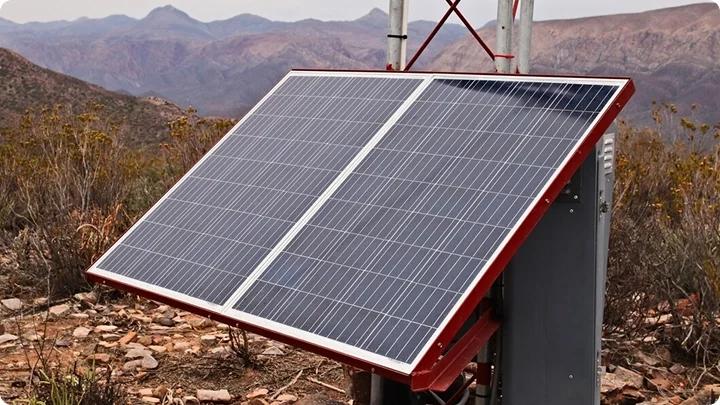
There is a distinction when sourcing equipment for commercial facilities or for residential backup projects. A Solar Equipment Factory should provide components that are compatible and will work together under defined operating conditions, not components that have nominal ratings that are the same.
At JSDSolar, we can provide hybrid inverters and LiFePO4 batteries to build storage architectures as required. We define storage architecture based on the behavior of the load and the operating limits of the components.
1. Hybrid System Architecture: DC-Coupled or AC-Coupled?
Coupling architecture determines how the system operates when the grid is down and how solar energy gets to the battery.
With DC-coupling, the solar generation passes through MPPT to the inverter's DC stage. Under certain conditions, this arrangement can avoid AC to DC conversion losses.
With AC-coupling, solar generation passes through a PV inverter to the AC line and then to a battery. It can be a good retrofit option, but has added control complexity for backup operation.
The following questions should influence the architecture choice:
•Is this a new or a retrofit system? A new system may benefit from a hybrid inverter with built-in MPPT. An existing system may benefit from AC-coupling.
•Will solar generation be curtailed during outages? AC-coupled PV must perform compatible grid-forming functions and curtail generation when battery charging or demanded load is less than generation.
•Is export permitted? Zero-export applications require appropriate metering, inverter response and control settings.
For AC-coupled systems, frequency-shift power reduction or other supported curtailment mechanisms must be verified with the actual PV inverter. Communication compatibility can not be assumed from equipment ratings.
2. Battery Discharge Limits Can Override Inverter Capacity
Two products available in the JSDSolar product line are:
•J8KHP Hybrid Inverter: 8kW class AC output, 48V nominal battery interface, and 190A battery charge/discharge current.
•LD48200 LiFePO4 Battery: 51.2V nominal, 200Ah, 10.24kWh nominal energy, 100A nominal discharge current.
At nominal voltage, the battery's nominal discharge power is:
51.2V x 100A = 5.12kW
Therefore, in order to discharge the battery to provide an 8kW AC load, approximately 164A at 51.2V would be required, assuming 95% inverter conversion efficiency for this calculation.
There is a size issue rather than approval for pairing these models.
BMS Communication Must Be Verified at Protocol Level
JSDSolar batteries support both CAN and RS485 communication. However, a common communication interface doesn't always mean a common format of message frames and charging logics.
Prior to giving the final approval of an inverter-battery combination, the engineers need to verify the following:
•Current limit transmission: The inverter dynamically follows the charge and discharge limits transmitted by the BMS.
•SOC sync: The inverter changes its SOC threshold syncing to the capacity reported by the BMS.
•Communication loss: The system enters a failure mode, in case communication is lost.
•Parallel operation of battery packs: The packs coordinate addressing and current sharing as well as protection events during parallel operation.
An acceptance test should demonstrate operation at low state of charge (SOC) and simulate loss of communication of the BMS using the approved test procedure provided by the manufacturer.
3. MPPT Configuration Must Match Actual PV String Conditions
Inverter PV input capacity alone does not establish a valid string design.
The JSDSolar J8KHP specifies four MPPT trackers, a 120–500V MPPT operating range, and 500V maximum DC input voltage.
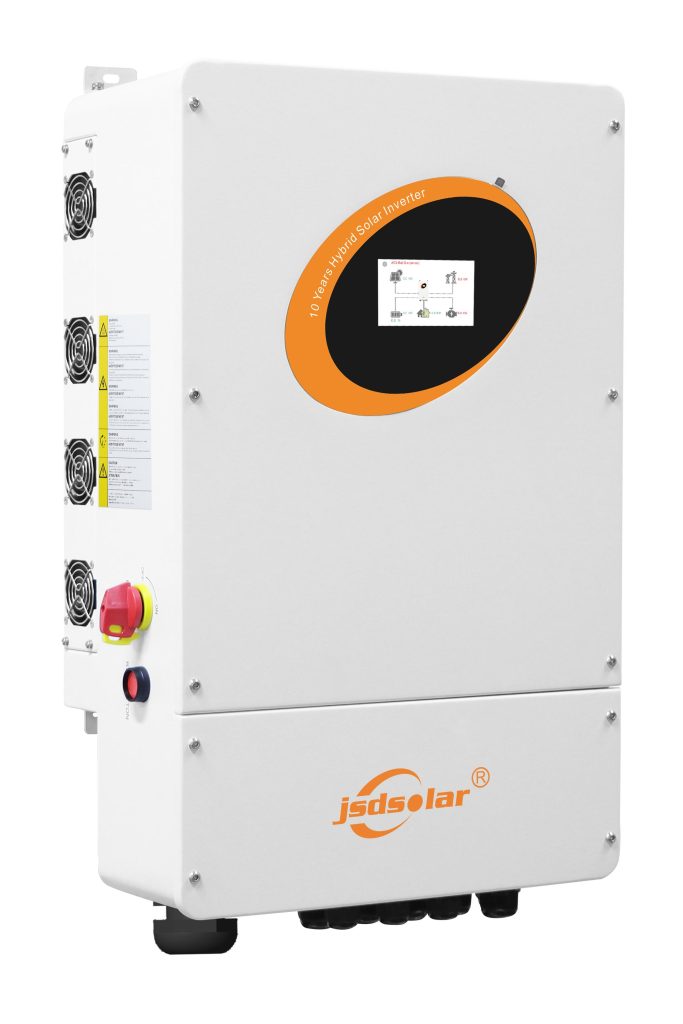
These values introduce two design boundaries.
Module open-circuit voltage increases as cell temperature decreases. String Voc must remain under the site's design minimum (i.e., anticipated lowest) operating temperature to remain under the inverter's absolute maximum input voltage.
As cell temperatures increase, module operating voltage decreases. The string voltage must be within the range supported by the MPPT for the module operating conditions.
Key design checks are to:
•Correct string Voc and Vmp for cell temperature based on the module data sheet.
•Confirm operating current and short circuit current are within the limits of the MPPT inputs, respectively.
•Where independent tracking is beneficial (e.g. differing array orientations or shading), separate tracking arrays.
The J8KHP has an oversizing factor of up to 12kW DC input against an 8kW AC output class. This oversizing factor does not mean all PV power is utilized. Battery charging, power export limits and local load demand may cause generation curtailment.
4. EMS Control and Backup Performance Require Different Tests
The energy management system (EMS) must perform more than switch between solar and battery. It must consider limiters on the inverters and batteries, and the availability of power.
| Operating condition | Expected system response | Verification focus |
| Battery reaches maximum permitted SOC | Reduce or stop charging; manage excess PV | BMS response and PV curtailment |
| Large motor starts | Supply transient power within inverter and battery limits | Surge capability and DC voltage sag |
| Utility supply fails | Isolate the grid and energize designated backup loads | Transfer interruption and load recovery |
| Battery temperature rises | Apply BMS-directed current reduction | Thermal derating response |
| Grid export limit is active | Adjust grid-connected output using meter feedback | Export overshoot and response delay |
Grid-connected and backup modes also involve different protection requirements.
During a utility outage, the inverter has to stop energizing the utility connection and supply the loads on the backup circuit if the model provides this feature. Check the transfer time to see if it is acceptable to the connected loads.
For split-phase and three-phase applications, evaluation of phase loading, neutral arrangements and grounding is needed. Compatible voltage alone does not prove suitability with the local distribution system.
5. What Should Buyers Verify with a Solar Equipment Factory?
Factory evaluation must be focused on repeatable tests, test evidence, and configuration traceability.
Before placing a large quantity order, it is advisable to define acceptance criteria.
Electrical and Integration Checks
•Ask for inverter derating at working load and check the battery models that have been certified for use.
•Confirm communication protocols and firmware versions.
•Review protection behavior in case of undervoltage, overload and loss of the grid.
•Check the applicable requirements for grid connection and comply, where applicable, with company-specific documents.
Production and Delivery Checks are Complete
•Agree on criteria for functional inspection and recorded test results.
•Establish revision control for hardware and Firmware.
•Confirm wiring diagrams, installation and commissioning instructions.
•Define how component substitutions and firmware changes will be communicated.
For high-ambient-temperature installations, the ability of the inverter to continuously deliver rated output is of critical importance. Inverters dissipate a substantial amount of energy and can only do so for a limited time before they thermal shut-down. Inverters are constantly switching and dissipating energy, heating up the magnetic components, and cooling the enclosure.
A short test at room temperature provides little evidence regarding the inverter's ability to maintain output under extreme thermal conditions.
JSDSolar provides solar storage solutions for residential and commercial applications. Please visit www.jsdsolar.com, for more information.
FAQs
Q1. What hybrid energy storage products does JSDSolar supply?
JSDSolar supplies hybrid solar inverters, LiFePO4 batteries, residential energy storage systems, and commercial solar storage solutions.
Q2. Can JSDSolar provide complete hybrid solar energy systems?
Yes. JSDSolar offers solar system configurations integrating PV panels, hybrid inverters, battery storage, and related accessories. Final specifications depend on project requirements.
Q3. How does JSDSolar match hybrid inverters with LiFePO4 batteries?
Matching considers battery voltage, discharge current, inverter power, BMS communication protocols, and firmware compatibility. Model-specific verification is required.
Q4. Does JSDSolar support CAN and RS485 battery communication?
Yes. Selected JSDSolar batteries and inverters support CAN and RS485 interfaces. Compatible communication protocols must be confirmed for each equipment combination.
Q5. What MPPT configuration does the JSDSolar J8KHP inverter offer?
The J8KHP provides four MPPT trackers, up to 12kW PV input, and a specified 120–500V MPPT operating range.
Share on Social:


- NEXT: Off Grid Solar System with Inverter: Pure Sine Wave Performance
- NEXT: Null
In This Article
- 1 1. Hybrid System Architecture: DC-Coupled or AC-Coupled?
- 2 2. Battery Discharge Limits Can Override Inverter Capacity
- 3 3. MPPT Configuration Must Match Actual PV String Conditions
- 4 4. EMS Control and Backup Performance Require Different Tests
- 5 5. What Should Buyers Verify with a Solar Equipment Factory?